
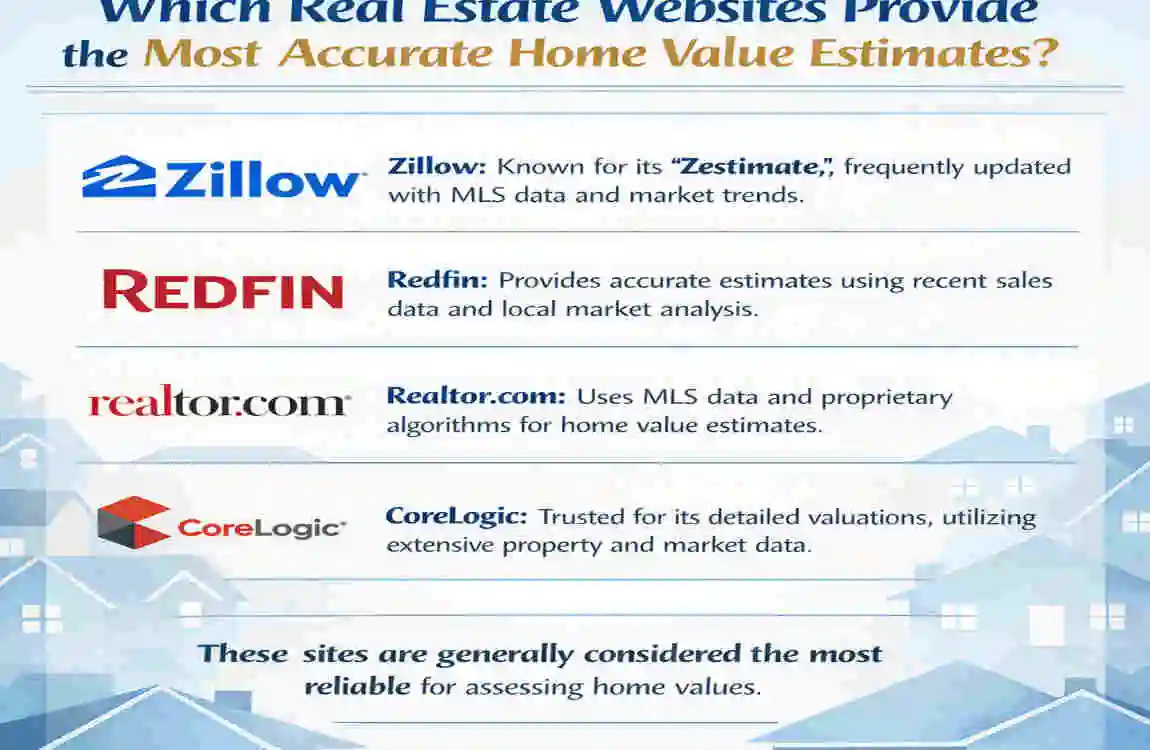
If you are asking which real estate website has the most accurate estimates, the short answer is: it depends on the location and the data available. Online home value tools are helpful, but they are not always exact.
These estimates matter because a small pricing mistake can lead to a big difference in buying, selling, or refinancing decisions. That is why many people check Zillow, Redfin, and Realtor.com before making a move.
Each site uses an automated system to guess a home’s value based on recent sales, property details, and market trends. Still, no website can know everything about your home, such as updates, repairs, or special features.
What Are Online Home Value Estimates?

Online luxury home value estimates are computer-generated price guesses. These tools are often called automated valuation models, or AVMs for short.
How they work
They look at things like:
- Recent home sales in the area
- Square footage and lot size
- Number of bedrooms and bathrooms
- Market trends and demand
- Public property records
Why are they not perfect
These tools can miss important details. For example, a brand-new kitchen, a finished basement, or a damaged roof may not appear in public data right away. That is why the number you see online should be treated as a starting point, not the final answer.
Why Accuracy Differs Between Websites
Not every real estate site uses the same data. Some update more often. Some have better local market access. Others rely more on public records.
The main reasons estimates differ
- Different data sources
- Different update speed
- Different algorithms
- Different local market coverage
Urban homes are often easier to estimate because there are more sales nearby and more data to compare. Rural homes can be harder because there are fewer recent sales and less local information.
Best Real Estate Websites for Home Estimates
Here is a simple comparison of the top platforms.
Website Strengths Weaknesses Best For
Zillow Large database, fast estimates Can be off in some markets Quick general estimate
Redefine Frequent updates, strong MLS data Less accurate in rural areas Metro and active markets
Realtor.com Solid listing data, MLS-linked Less transparent algorithm Listing-based valuation.
Zillow
Zillow’s Zestimate is one of the most popular home value tools. It is fast, easy to use, and gives a broad view of market value. However, it can sometimes overestimate or underestimate, especially in areas with fewer recent sales.
Redfin
Redfin Estimate is often considered one of the stronger options in busy housing markets. It tends to update more often and uses strong MLS data. If you want a closer market-based estimate, Redfin is a good place to start.
Realtor.com
Realtor.com offers useful luxury home value estimates tied closely to listing data. It is a reliable option for checking what homes are selling for, though its estimates may not always update as quickly as those of other tools.
Which Real Estate Website Has the Most Accurate Estimates?
The answer is not the same for every home.
In urban areas
Redfin is often considered very strong because it updates frequently and uses good local data.
In suburban areas
Zillow and Redfin can both be useful, especially when paired with recent comparable sales.
In rural areas
All online tools can struggle more here because there are fewer sales to compare. In these areas, a local agent or appraiser is often more helpful.
Best overall advice
If you want the most accurate picture, do not rely on just one website. Compare at least three estimates and look for patterns. If two or three tools are close, that number is usually more trustworthy.
Factors That Affect Home Value Accuracy
Several things can change a home’s true value:
- Home condition
- Renovations not recorded online
- Neighborhood demand
- School district quality
- Market changes
- Seasonal shifts
For example, two similar houses may show different prices online if one has been remodeled and the other has not. Online tools may not always catch that difference right away.
How to Get the Most Accurate Home Value
To get a better estimate, follow these simple steps:
- Check multiple websites
- Compare recent nearby sales
- Talk to a local real estate agent
- Request a professional appraisal if needed
This mix of technology and human insight usually yields the best results.
Pros and Cons of Online Home Value Tools

Pros
- Fast and free
- Easy to use
- Good for a quick starting point
Cons
- Not always precise
- May miss luxury home upgrades
- Can lag behind the market
FAQ
Which real estate website has the most accurate estimates?
No single site is always the best, but Redfin is often very accurate in metro areas.
Is Zillow’s Zestimate reliable?
Yes, it is useful as a starting point, but it should not be the only number you trust.
Why do estimates change from site to site?
They use different data sources, update times, and pricing models.
Can I trust online home value estimates alone?
Not fully. They are helpful, but a local expert can give better insight.
What is the best way to find my home’s value?
Use multiple online tools, compare recent sales, and ask a real estate professional for guidance.
| Real Estate Site | Home Value Tool Name | Accuracy Highlight | Key Feature | |
|---|---|---|---|---|
| Redfin | Redfin Estimate | Most accurate overall | Machine learning + weekly market data updates | |
| Realtor.com | Realtor.com Home Value Tool | MLS-connected accuracy | Direct MLS connection with 900+ services | |
| Zillow | Zestimate | 1.83% median error (on-market) | Instant estimate; update with home facts | |
| Homes.com | Homes.com Estimator | Up-to-date active listings + closed sales | Straightforward interface | |
| Eppraisal | Eppraisal | Quick local market trends | Links to real estate professionals | |
| HomeGain | HomeGain Estimator | Investment return potential | Detailed reports + estimated value | |
| Chase | Chase Home Value Estimator | Mortgage database baseline | Free detailed equity report | |
| RE/MAX | RE/MAX Estimation Tool | Local agent insights | Personalized estimates |
