

Real estate has always been a popular way to build wealth. Still, it has also been expensive, time-consuming, and sometimes intimidating for beginners. In the past, if you wanted to invest in property, you usually needed a large amount of money, a good understanding of the market, and the willingness to deal with tenants, repairs, and ongoing management.
Today, things look very different. Fractional real estate investing has opened the door for everyday investors to get involved with much smaller amounts of money. One of the platforms getting a lot of attention in this space is Arrived. It promises a simple way to invest in rental homes and earn passive income without becoming a landlord.
That leads to the big question many people ask: Is real estate investing legit?
It is a fair question. Anytime money is involved, especially in a newer investing model, you want to know whether the platform is real, trustworthy, and worth your time. You want to know how it works, what the risks are, how the company makes money, and whether the returns are truly worth it.
What Is Arrived Real Estate Investing?

Overview of Arrived
Arrived is a platform that lets people invest in rental homes without buying the whole property. Instead of purchasing an entire house, you buy a small share of one or more properties through the platform. This gives you exposure to real estate while keeping the entry cost much lower than traditional property ownership.
The idea behind Arrived is simple. It wants to make real estate investing easier, more affordable, and more accessible to people who may not have enough capital to buy a home outright. The company presents properties, shares information about expected performance, and allows investors to invest in small amounts.
This model has become attractive because it removes many of the headaches that come with direct ownership. You do not need to screen tenants, fix broken appliances, or manage the property yourself. Arrived and its partners handle much of that work.
In other words, it is designed for people who want exposure to real estate but prefer a more hands-off approach.
Fractional Ownership Explained
Fractional real estate investing means owning a small portion of an asset rather than the entire asset. In this case, the asset is a rental property. You may invest a relatively small amount and, in return, receive a share of the income and potential appreciation.
This model makes real estate more approachable for beginners. Many people like the idea of earning passive real estate income but cannot afford a down payment, closing costs, or the ongoing expenses that come with buying a property directly. Arrived lowers that barrier.
For example, instead of needing tens of thousands of dollars to buy a rental home, you might be able to start with a much smaller investment. That makes it easier to test the waters, spread your money across different properties, and learn how real estate investing works without taking on too much risk at once.
For newer investors, that can feel like a welcome middle ground between saving in cash and jumping into full property ownership.
Has Arrived Real Estate Investing Legit?
This is the question that matters most. The short answer is yes, Arrived appears to be a legitimate platform, but like all investments, it comes with risks. It is not a magic money machine, and it is not risk-free. But it does operate as a real investment platform with real properties, real offering details, and a business structure that appears to be built around regulated investment activity.
To understand legitimacy, it helps to look at a few key areas: company credentials, user reputation, and outside support or partnerships.
Company Credentials
One of the first things to check when deciding whether any investment platform is real is whether it follows the proper rules. Arrived presents itself as a platform offering SEC-qualified investment offerings, which is important. That means the company is not just asking for money without oversight. It is working within a regulated investment framework.
This is a strong sign of legitimacy.
The platform also provides property-level information, including expected rental income, projected returns, and key details about each home. That kind of transparency matters. Legitimate platforms typically explain what investors are buying, how the investment may perform, and what risks exist. They do not hide everything behind vague promises.
Still, you should remember that regulated does not mean guaranteed. It only means the offering is operating under the rules required for this type of investment. Your returns still depend on how the property performs and how the market behaves.
That is why reading each offering carefully is so important. A platform can be legitimate and still not be right for every investor.
Reputation and User Reviews
When people search for an Airbnb home review, they often want to know what real users think after trying the platform. Overall, feedback tends to focus on the same major themes: convenience, accessibility, and the appeal of passive real estate income.
Many users appreciate how easy it is to get started. They like the low minimum investment, the clean presentation of properties, and the ability to invest in real estate without becoming landlords. For people who have never bought a rental home before, that simplicity can feel refreshing.
At the same time, some investors are cautious. They point out that returns may be modest, properties may take time to generate meaningful income, and liquidity can be limited. That is normal. Any honest review of an investment platform should include both the positives and the drawbacks.
A good sign is that Arrived does not rely on unrealistic hype. It does not promise overnight riches. Instead, it positions itself as a long-term, income-focused real estate platform. That makes it feel more grounded and credible.
In general, the reputation suggests that Arrived is real, active, and widely used by investors who want a simple way to access real estate.
Backing and Partnerships
Another clue that helps answer whether real estate investing is legit is the company’s backing. Arrived has attracted attention from notable investors and supporters, which adds to its credibility. When respected people or institutions support a platform, it often means they have reviewed the business and see real potential in it.
That does not mean every property on the platform is a perfect investment. It simply means the business itself has gained enough attention and trust to grow seriously.
Partnerships also matter because they can improve operations, property access, and platform quality. A company that can build relationships in the real estate and finance world usually has more staying power than one that works in isolation.
So while you should never invest based only on branding or outside support, this kind of backing is still a positive sign.
How Does Arrived Make Money?
Understanding how a platform earns money helps you understand whether its interests align with yours. Arrived makes money in a few straightforward ways.
Fee Structure
Like most investment platforms, Arrived charges fees for its services. These may include asset management fees and property management costs. That covers the work involved in selecting properties, managing operations, handling maintenance, and making the investment experience smoother for users.
These fees are important because they affect your overall return. Even if a property performs well, fees can reduce the amount that reaches investors. That is not unusual. The key is to understand the fee structure before you invest.
A legitimate platform should be clear about how fees work. You should never feel like you are discovering charges only after you commit money. With Arrived, the goal is to provide that information upfront.
Revenue Sources
Arrived’s business model is tied to the underlying properties. The platform and its investors may benefit from two main sources:
- Rental income
- Property appreciation
Rental income comes from tenants paying to live in the home. That income can be distributed to investors after expenses and fees are handled.
Property appreciation happens when the home’s value rises over time. If the property is sold at a higher price in the future, investors may benefit from that increase.
Of course, neither of these outcomes is guaranteed. Homes can lose value. Tenants may move out. Repairs may cost more than expected. That is why any real estate investment should be viewed as a long-term opportunity, not a quick win.
Benefits of Investing Through Arrived
There are several reasons why people are drawn to Arrived. For many investors, the platform offers a practical way to enter the real estate market without the usual barriers.
Low Minimum Investment
One of the biggest advantages is the low starting amount. In many cases, investments begin at around $100. That makes the platform much more accessible than buying a rental property on your own.
This low barrier is especially helpful for beginners. You do not need to wait years to save a large down payment to participate. You can start small, learn the process, and grow from there.
That flexibility can make investing feel less overwhelming.
Diversification Opportunities
Diversification means not putting all your money into one place. Arrived makes this easier by allowing you to spread your funds across multiple homes and markets instead of relying on a single property.
That matters because real estate is not always predictable. One home may perform well while another underperforms. By spreading your investment, you reduce the chance that one bad property will have too much impact on your overall returns.
For many people, this is one of the strongest reasons to use a fractional real estate investing platform instead of buying a single property directly.
Passive Income Potential
People often look at Arrived for passive real estate income. That means income that does not require daily work from you. Once you invest, the goal is to receive distributions from rental activity while the platform handles the heavy lifting.
This can be attractive if you want your money to work for you without spending evenings dealing with tenants or weekends fixing leaks.
Still, it is important to keep expectations realistic. Passive income is not the same as guaranteed income. Some properties may produce steady returns, while others may underperform. But compared with direct landlord work, Arrived is much more hands-off.
Professionally Managed Properties
Another benefit is professional management. Instead of handling maintenance calls, leasing issues, and rent collection yourself, the platform and related teams manage the property operations.
That is useful for people who want exposure to real estate without the burden of being a landlord. If you have ever dealt with repairs, vacant units, or difficult tenant situations, you already know how much time that can take.
With Arrived, the burden is shifted away from you, making investing feel more manageable.
Access to Real Estate Without Landlord Duties
Perhaps the most appealing part of the platform is this: you can invest in real estate without acting like a landlord. You do not have to screen tenants, handle emergencies, or fix every issue yourself.
That is a big deal for beginners and busy professionals. It lets you enjoy the investment side of real estate without the day-to-day stress that often comes with direct ownership.
For many investors, that convenience is exactly what makes Arrived interesting.
Potential Risks and Drawbacks
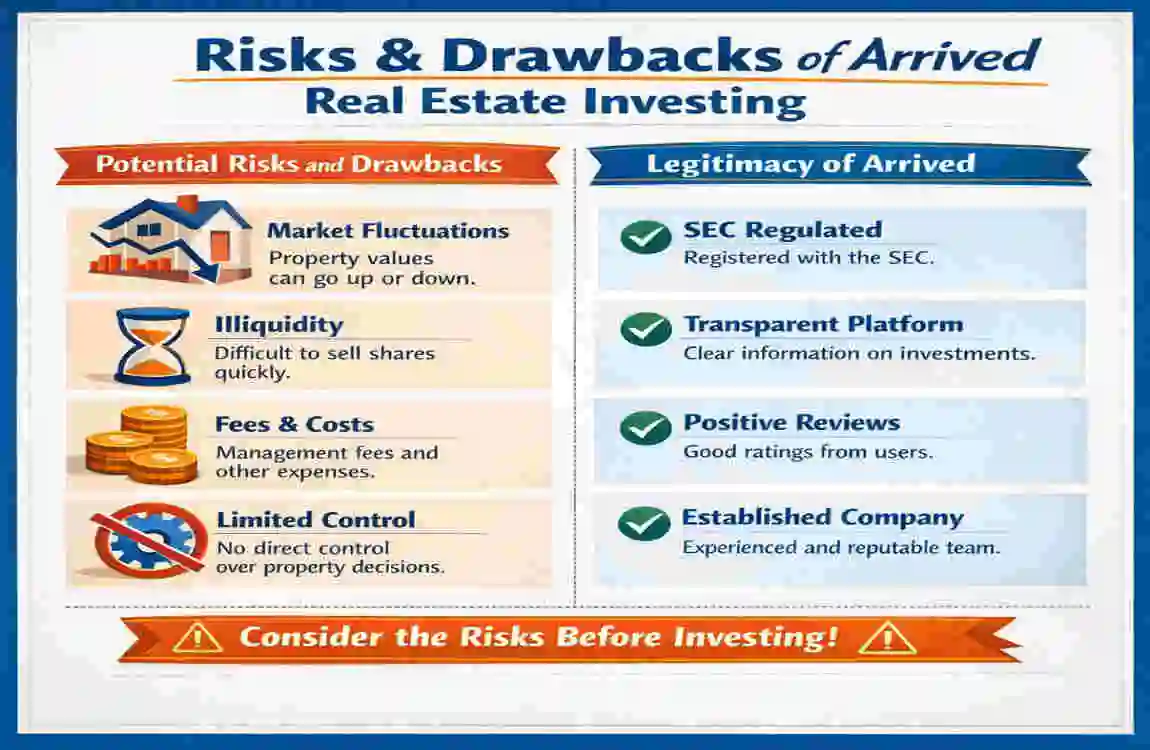
No investment platform is perfect, and Arrived is no exception. If you are trying to decide whether it fits your goals, you need to consider the risks as well.
Real Estate Market Fluctuations
Real estate values do not always go up. Markets can cool, neighbourhoods can change, and property prices can fall. If a property loses value, your investment may not perform the way you hoped.
This is one of the main risks in any real estate investment, including Arrived. Even if the platform is legitimate, the market itself can still move against you.
That is why long-term thinking is so important. Real estate often works best when investors stay patient and avoid expecting fast returns.
Limited Liquidity
One of the biggest drawbacks is liquidity. In simple terms, this means how easily you can access your money. With stocks, you can usually sell quickly. With real estate, it is much harder.
Investments that have arrived are not as easy to cash out as public stocks or ETFs. Your money may be tied up for a longer period, and that can be a problem if you need quick access to cash.
If you think you may need your money soon, this platform may not be the best fit.
Property Performance Risks
Every property has its own risks. A home may have higher-than-expected repair costs, longer vacancy periods, or slower rent growth. Even a well-located property can run into issues.
This means your return depends not only on the general market but also on the specific property you chose. One property may do well while another struggles.
That is why it helps to review each opportunity carefully rather than assuming every listing is the same.
Platform-Related Risks
There is also platform risk. Any time you invest through a company rather than directly in an asset, you rely on that company’s systems, operations, and business health.
If the platform has operational problems, policy changes, or other challenges, investors could feel the effects. That does not mean Arrived is unsafe, but it does mean you should not treat it as risk-free.
A smart investor always considers both the property risk and the platform risk.
Fees That May Impact Returns
Fees are not necessarily bad, but they do matter. If the platform charges for management and operations, those costs can lower your net returns. The property might perform reasonably well, but your final results may still be smaller after fees.
This is why comparing projected returns to actual income matters. You want to know how much you may really keep after everything is taken out.
Always read the details carefully before committing money.
Arrived vs Traditional Real Estate Investing
To better understand Arrived, it helps to compare it with buying a rental property directly.
Feature Arrived Traditional Real Estate
Minimum Investment Low High
Property Management Included Self-managed
Liquidity Limited Limited
Diversification Easy More Difficult
Time Commitment Low High
This table shows why Arrived appeals to so many people. It lowers the cost, saves time, and makes diversification easier. Traditional real estate can offer more control, but it also requires more money, more effort, and more responsibility.
If you want hands-on control, direct ownership may be better. If you want simplicity and lower entry costs, Arrived may feel more practical.
Who Should Consider Arrived Investing?
Arrived is not for everyone, but it may be a good fit for certain types of investors.
Beginner Investors
If you are new to real estate, Arrived can be a gentle way to start. It gives you exposure to property investing without the pressure of owning a full home.
You can learn how real estate income works while keeping the process relatively simple.
Passive Income Seekers
If your goal is to earn income without becoming a landlord, this platform is worth looking at. It is built for people who want a more passive experience.
That makes it attractive for busy professionals, side-income seekers, and people who prefer convenience.
Diversification-Focused Investors
If you already invest in stocks, bonds, or cash savings, real estate can add variety to your portfolio. Arrived makes that easier by letting you spread your money across different properties.
That can help balance your overall strategy.
Long-Term Investors
Real estate usually works best over time. If you are patient and willing to hold your investments for the long run, you may be better suited for this kind of platform.
If you want fast trades and quick exits, Arrived may feel too slow.
Frequently Asked Questions
. Is real estate investing legit?
Yes, Arrived is a legitimate fractional real estate investing platform. It offers SEC-qualified real estate investments, but like all investments, it carries risk.
. What is the minimum investment on Arrived?
Many offerings start at around $100, which makes it easier for beginners to get started with real estate investing.
. Can I lose money investing with Arrived?
Yes. Property values can fall, rental income may change, and market conditions can affect your returns.
. How do investors earn money on Arrived?
Investors may earn through rental income distributions and possible property appreciation over time.
. Is Arrived safe for beginners?
Arrived is beginner-friendly, but it is still important to understand the risks before investing.
. How does Arrived compare to buying a rental property directly?
Arrived requires less money, less management, and less time than direct ownership. It also makes diversification easier, though it gives you less control.
| Aspect | Information |
|---|---|
| Investment Type | Real estate investing involves purchasing property to generate income, appreciation, or both. |
| Legitimacy | Yes, real estate is a legitimate and widely recognized investment option used by individuals, businesses, and institutions worldwide. |
| Common Types | Residential rentals, commercial properties, vacation rentals, REITs (Real Estate Investment Trusts), and land investments. |
| Potential Benefits | Passive rental income, long-term property appreciation, tax advantages, and portfolio diversification. |
| Risks | Market fluctuations, property maintenance costs, vacancies, economic downturns, and financing risks. |
| Initial Investment | Typically requires a larger upfront investment than stocks or bonds, though REITs offer lower-cost entry points. |
| Liquidity | Real estate is generally less liquid than stocks because properties can take time to sell. |
| Suitable For | Investors seeking long-term wealth building, income generation, and tangible assets. |
| Return Potential | Returns vary by location, property type, market conditions, and management quality. |
| Key Consideration | Thorough research, market analysis, and financial planning are essential before investing. |
